
FAQs & Technical Guides
Explore steel grades and find the information you need on product selection, coatings and technical documents.
THE RIGHT INFORMATION.
Explore the Properties of Steel
22 technical topics · 16 questions
Hardox® 500: hardness and fabrication properties
Hardox 500 sheet and plate hardness, and why it must not be confused with Hardox 500 Tuf.
View Technical PropertiesStrenx® 700: product family and strength selection
Strenx 700 is not a single delivery format: specify the exact product and thickness.
View Technical PropertiesStrenx® 700MC D/E: mechanical properties and bending
Thickness groups, tensile strength and minimum internal bend radius for 700MC D/E.
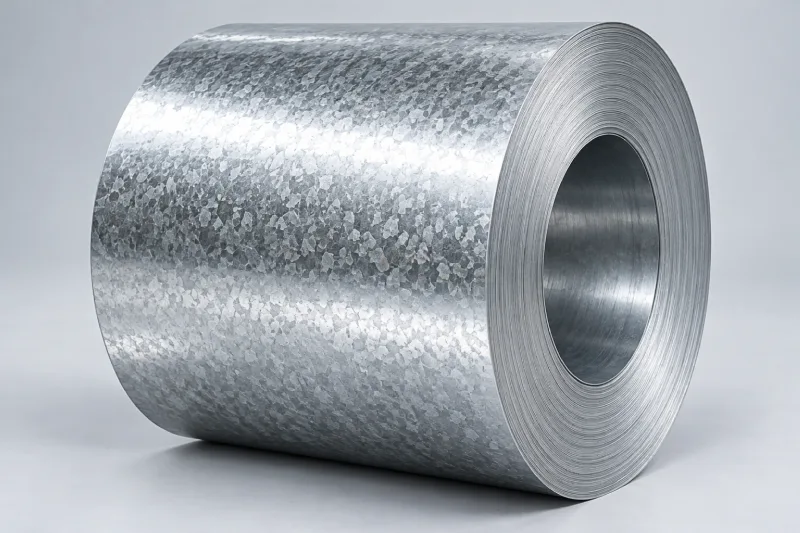
View Technical PropertiesGalvanised sheet: DX51D+Z and coating selection
Specify the base steel grade and zinc coating separately: DX51D, DX52D–DX57D and Z classes.
View Technical PropertiesZ100–Z275: understanding zinc coating mass
Z275 does not mean 275 g/m² on each side: total coating mass versus thickness in microns.
View Technical PropertiesPre-painted sheet: paint systems, RAL colours and coating layers
The role of polyester, HDP, PUR-PA and PVDF systems in product specifications.
View Technical PropertiesTrapezoidal sheet: profile, effective width and load tables
Profile geometry and coverage using 27/200 as an example, with load-table conditions to check.
View Technical PropertiesSinusoidal corrugated sheet: 18/76 profile and effective width
Wave geometry, sheet width and net coverage after overlap.
View Technical PropertiesGalvanised wire: diameter, coating and tensile classes
When purchasing galvanised wire, specify coating and tensile strength as well as diameter.
View Technical PropertiesClear Answers. Practical Information.
When should Hardox® be selected?
Hardox is a family of wear-resistant steels for applications involving abrasive material. Specify the product grade, thickness and operating conditions, not just the brand. Hardox 400 properties cannot be generalised to all Hardox grades.
Source: SSAB — Technical reference ↗What is the hardness of Hardox® 400?
SSAB’s data sheet lists a hardness range of 370–430 HBW for Hardox 400. Check the test method and thickness-dependent conditions in the data sheet; special provisions apply below 2.5 mm. This range does not apply to other grades.
Source: SSAB — Technical reference ↗Do Strenx® and Hardox® serve the same purpose?
Strenx focuses on high-strength structural applications, whereas Hardox prioritises wear resistance. Selecting a higher-strength product does not replace project calculations. Final grade and thickness selection must consider loads, connections and fabrication conditions.
Source: SSAB — Technical reference ↗Does Strenx® 700 have 700 MPa yield strength at every thickness?
No. SSAB specifies minimum yield strength of 650–700 MPa for the Strenx 700 family, depending on product and thickness. Use the current data sheet for the exact product being purchased; one value cannot be applied to the whole family.
Source: SSAB — Technical reference ↗Why does thickness matter for S355?
Yield strength can vary with thickness. For example, the SSAB Multisteel SNL data sheet specifies a minimum of 355 MPa at 5–16 mm and lower minimum values at greater thicknesses. The grade name alone therefore does not describe every mechanical condition.
Source: SSAB — Technical reference ↗Why are S355J0, S355J2 and +N specified separately?
Grade suffixes and delivery condition identify different technical requirements. For example, S355J0+N and S355J2+N have different impact-test temperatures; +N denotes a normalised delivery condition. Use the complete grade code without omitting suffixes.
Source: SSAB — Technical reference ↗